


Nature - 2019 October - Vol 574 No 7778
Publisher: Nature
Format: Paperback
ISBN: 9770028083095
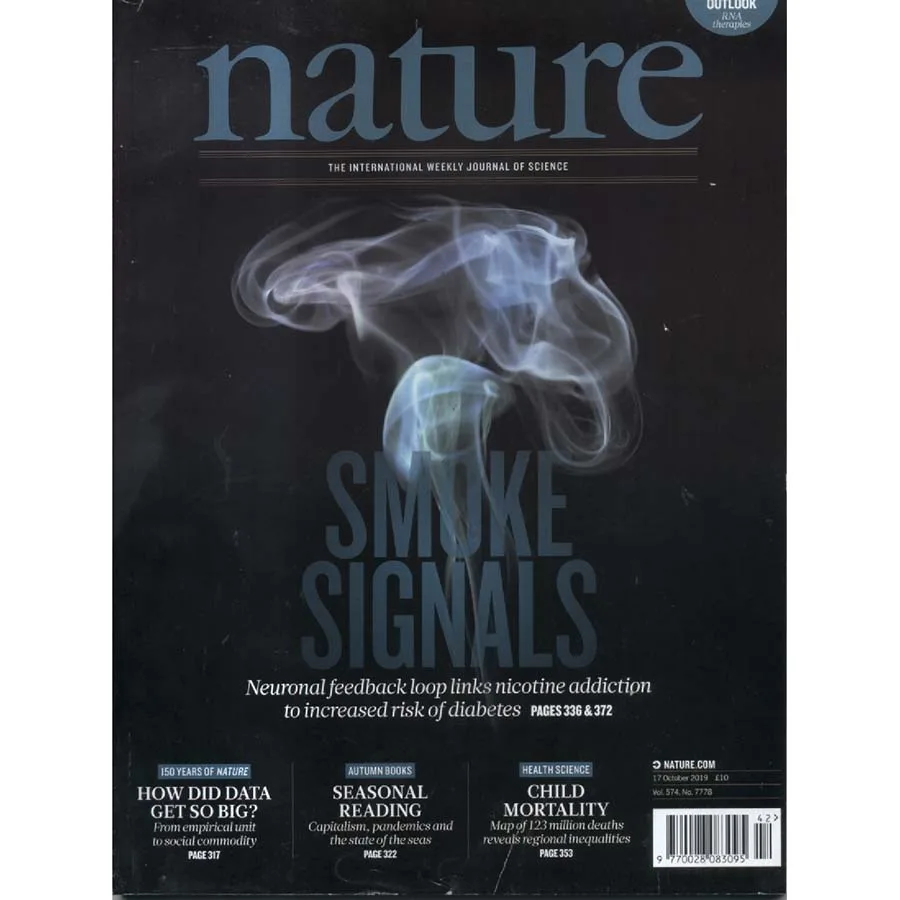
There are magazine covers that attempt subtlety, and then there are issues of Nature that place an enormous spectral plume of smoke across the front and calmly title it SMOKE SIGNALS while discussing nicotine addiction, diabetes risk and neuronal feedback loops. Nature – October 2019, Vol. 574 No. 7778 radiates the sort of elegant scientific menace only elite journals truly manage.
The cover itself is beautiful in a deeply unsettling way. Pale smoke curls upward through darkness like a ghost emerging from a laboratory experiment that has perhaps become slightly too self-aware. Modern scientific publishing has fully embraced cinematic aesthetics, and Nature increasingly resembles a prestige science-fiction series designed for people with PhDs and unresolved concerns about civilisation.
This issue’s central feature explores how nicotine addiction may be linked neurologically to increased diabetes risk — a reminder that the human body is apparently an impossibly interconnected system where one habit quietly negotiates with half a dozen other biological pathways behind the scenes. Scientists spend their lives uncovering these hidden relationships while ordinary humans continue optimistically believing they are simple creatures.
They are not.
Elsewhere in the issue:
-
researchers investigate the explosive growth of scientific data,
-
seasonal reading recommendations drift into the intellectual atmosphere,
-
and child mortality studies reveal stark regional inequalities,
which together create the wonderfully overwhelming impression that Nature is attempting to document the entirety of existence simultaneously. Few publications can move from neuroscience to social inequality to reflective autumn book recommendations without losing composure.
The irony of revisiting 2019 science journals now is extraordinary. At the time, these were cutting-edge contemporary discussions about health, technology and society. Today they read partly as intellectual archaeology from the final stretch of the pre-pandemic world — an era when global anxiety still felt comparatively theoretical and science journalism retained a certain calm confidence in the steady progress of knowledge.
And yet many themes here feel eerily prophetic:
-
public health,
-
addiction,
-
inequality,
-
information overload,
-
and the increasingly impossible scale of modern scientific data.
One begins to suspect the late 2010s were quietly trying to warn everyone about the coming decade while most people remained distracted by streaming subscriptions and phone batteries.
Still, Nature remains gloriously composed throughout. Scientific journals possess an extraordinary tonal consistency even when describing deeply alarming realities. Entire public health crises may unfold, but the editorial layout remains tasteful and somebody still carefully italicises Latin terminology.
The visual culture of Nature deserves admiration too. Scientific publishing now routinely produces imagery more artistically sophisticated than much of contemporary gallery art. Smoke becomes abstraction. Molecular structures resemble sculpture. Data visualisation turns into conceptual design. One could frame this cover and convince guests it represents a meditation on mortality, addiction or late capitalism.
In fairness, it probably does all three accidentally.
Physically, this issue carries the unmistakable aura of intellectual seriousness. One imagines it originally sitting in:
-
university libraries,
-
hospital departments,
-
research institutes,
-
or beside untouched coffee in offices occupied by people capable of discussing neuronal pathways before breakfast.
Yet now it survives as a fascinating cultural object from a moment when science was simultaneously becoming more advanced, more visual and more urgently connected to everyday global concerns.
Condition-wise, this copy is listed as Good, meaning it has survived admirably despite likely exposure to laboratories, academic desks and perhaps at least one reader who opened the nicotine-diabetes article intending casual interest before accidentally discovering the terrifying complexity of human metabolism.
Today, Nature – October 2019, Vol. 574 No. 7778 stands as both scientific journal and intellectual time capsule: a snapshot of humanity studying itself with ever-increasing precision while still trying to understand the consequences of its own behaviour.
An excellent acquisition for science enthusiasts, collectors of modern academic ephemera, lovers of striking magazine design or anyone who appreciates publications capable of making them feel simultaneously informed, thoughtful and faintly concerned about the biochemical machinery operating quietly inside them.
Keep browsing: See more Nature Journal books Other books by Nature
